
For decades, the data center industry operated on a linear growth curve. A “standard” enterprise rack drew 5kW; a “high-density” one drew 10kW. If you built a facility with raised floors and massive CRAH (Computer Room Air Handler) units, you were set for a fifteen-year lifecycle—give or take.
But as we cross into 2026, that linear curve has turned into a vertical wall. We have entered the era of Legacy Lock—a state where thousands of existing data centers are physically and electrically incapable of hosting the next generation of high-performance compute. Said another way; yesterdays infrastructure cannot meet tomorrows demand. Which is why, we’re calling 2026 to be the year of the “Infrastructure Reset”.
Does my ‘Rack’ look big in this?
The fundamental problem is one of concentration. In 2020, a data center suite might have been designed for an average of 150 watts per square foot. Today, AI clusters powered by NVIDIA Blackwell or AMD Instinct chips require upwards of 1,000 to 2,000 watts per square foot.
This isn’t an incremental upgrade; it is an entirely different category—and it requires a complete engineering rethink:
-
The Weight Issue: A fully loaded AI rack can exceed 6,000 lbs. Most legacy raised floors were rated for 2,500 to 3,000 lbs. To host modern AI, you don’t just need more power; you literally need a stronger building.
-
The Cooling Ceiling: Air is a poor conductor of heat. Once a rack exceeds 30kW, you cannot move enough air through the chassis to keep the chips from “thermal throttling” (slowing down to stay alive).
Sixty percent (60%) of legacy data center distribution limits are now being exceeded by AI workloads. We are seeing a “stranded capacity” crisis where operators have megawatts available at the building’s entrance, but cannot get that power to the rack or the heat out of the room.
2026: The Year of the “Infrastructure Reset”
Why is 2026 the tipping point? Because the first wave of “AI-Native” facilities—purpose-built for liquid cooling and gigawatt-scale loads—is coming online this year.
For the legacy operator, 2026 is a year of reckoning. You are no longer competing with the guy down the street; you are competing with “AI Factories” designed with 800V DC power distribution and Direct-to-Chip (DTC) liquid cooling as the baseline.
If your facility requires a tenant to “bring their own cooling” or “derate their hardware” to fit your airflow, you aren’t a Tier 3 data center anymore—you are a legacy warehouse.
The “Brownfield” Opportunity (and its Pitfalls)
Because the lead time for new “Greenfield” utility interconnections has stretched to 4–8 years in major markets like Northern Virginia or Dallas, there is a desperate rush to retrofit “Brownfield” (existing) sites.
However, retrofitting is where most “Legacy Lock” disasters happen.
-
The Piping Problem: Bringing water to the rack requires a massive overhaul of mechanical piping. Legacy sites weren’t built with the ceiling clearance for 6-inch headers or the floor space for CDUs (Coolant Distribution Units).
-
The Power Path: Moving from 480V to the rack-level 800V DC needed for efficiency requires more than just new PDUs. It often requires a complete rethink of the UPS and transformer sequencing.
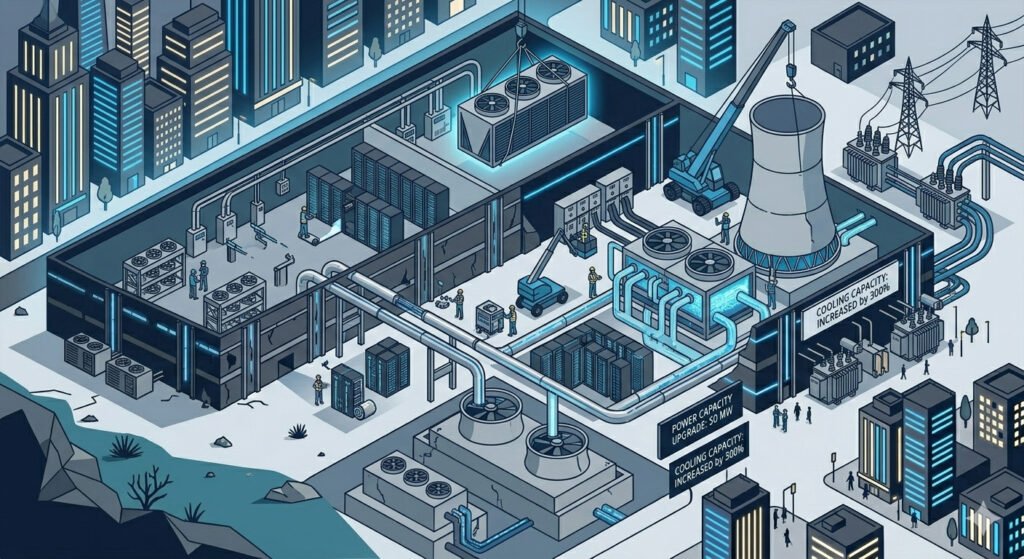
At LOADLINE, we believe the strategy for 2026 isn’t a full-scale demolition. It’s “Surgical Retrofitting.” This involves carving out high-density “AI Pods” within a legacy hall—isolating the high-heat, high-weight racks and feeding them with dedicated liquid loops while leaving the rest of the facility air-cooled for traditional enterprise “bread and butter” workloads.
The Economic Fallout: The Great Repricing
As capacity tightens, we are seeing a massive shift in how data center space is valued. In the “Real Estate Era,” you paid for square footage. In the “Infrastructure Era,” you pay for Resource Availability (usually measured in units of power).
Occupancy rates for high-density ready infrastructure are projected to peak at 95% by late 2026. If you have a facility that can actually handle a 60kW rack today, you aren’t just an operator—you are holding the most valuable “currency” in the digital economy. Conversely, if your facility is locked in the “5kW per rack” era, your valuation is at risk of a significant write-down.
The LoadLine Perspective: Unlocking the Lock
At LOADLINE, we don’t look at a data center as a building; we look at it as a Thermal and Electrical Envelope.
Our role is to help our clients navigate the “Reset” by:
-
Auditing for “Stranded Capacity”: Finding where your legacy design is leaving power on the table because of cooling or weight constraints.
-
Bridging the Technical Gap: Translating the hyperscale “wish list” into what is actually possible within your existing four walls.
-
Future-Proofing the Negotiation: Ensuring that new MSAs (Master Service Agreements) account for the inevitable shift to liquid cooling and higher densities without triggering catastrophic OpEx spikes.
This is not a drill. The “Infrastructure Reset” isn’t coming; it’s here. The “Legacy Lock” will claim those who refuse to adapt their physical shells to the reality of the silicon they host.
Sources:
-
Goldman Sachs: Data Center Occupancy and AI Power Demand. Source
-
TrendForce: AI Rack-Level Power Density Surge (50kW to 1MW). Source
-
TechArena: 8 Ways AI Will Rewrite Data Center Infrastructure in 2026. Source
-
Nautilus Data Technologies: Retrofitting Pitfalls for AI Workloads. Source