
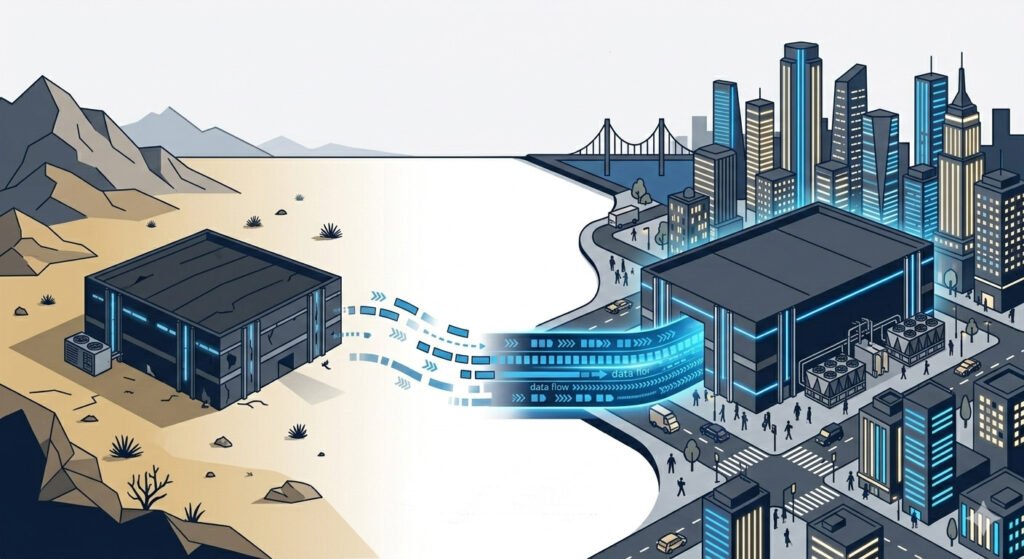
As AI and real-time processing collide with the laws of physics, the centralized datacenter model is reaching its breaking point.
For the better part of a decade, the narrative of digital transformation was one of massive centralization. The “Cloud” was a handful of hyperscale campuses in Tier 1 markets—Northern Virginia, Dublin, Singapore—where economy of scale was the only metric that mattered. But as we move into the era of pervasive agentic AI, autonomous systems, and industrial IoT, the laws of physics are beginning to overwhelm the laws of economics.
The “Rush Towards the Edge” is not just a trend; it is a structural necessity. We are witnessing the decentralization of compute, driven by a collision between skyrocketing data volumes and the fixed speed of light.
The Physics of the “Latency Tax”
In a centralized world, a 100-millisecond round-trip delay was an acceptable annoyance for an email or a web page. In the world of AI-Inference-at-the-Edge, it is a failure state.
While you and I can give concessions to ChatGPT or Gemini (or pick your favorite bot) for taking several seconds to reply to our request for suggesting flour varieties for our next bake—consider the scenarios where timing is critical. When an autonomous vehicle or an automated factory floor requires a split-second decision from an AI model, the data cannot afford the “transit tax” of traveling 500 miles to a core data center and back. Consider the Autonomous Vehicle (AV) ecosystem: a single AV can generate up to 4 terabytes of data per day. Uploading even a fraction of that to a central cloud for real-time processing is technically impossible and economically, well… it’s bad.
According to IEEE research, for haptic internet and tactile feedback systems (the “Internet of Skills”), latency must be kept under 1 to 5 milliseconds. To achieve this, the compute resource must be physically located within 10 to 50 miles of the end-user. This is the “Edge” in its truest sense—the shift from regional hubs to neighborhood-level compute.
The Bandwidth Bottleneck and “Data Gravity”
As data volumes grow, they develop “gravity.” The more data an application generates at a specific location, the harder it is to move.
Historically, we moved the data to the compute. Today, we are forced to move the compute to the data. Gartner projects that by 2026, 75% of enterprise-generated data will be created and processed outside a traditional centralized data center or cloud.
If you are a data center operator, this changes your value proposition. You are no longer just selling “Space and Power”; you are selling Proximity. The strategic advantage is shifting toward facilities that sit at the intersection of local fiber “on-ramps” and dense urban populations.
The Real-World Engineering Challenge: “The Density Dilemma”
This is where the “Rush to the Edge” hits the brick wall of reality. Building at the edge means building in constrained environments—basements, cellars, or repurposed urban industrial shells. These sites were never designed for the high-density requirements of modern AI.
While a hyperscale facility can spread 50MW over a massive footprint, an Edge site might need to pack 2MW of high-performance compute into a space the size of a shipping container.
-
-
The Power Gap: Traditional retail colocation was built for 5kW to 10kW per rack.
-
The AI Demand: Today’s NVIDIA H100 or Blackwell clusters are pushing demand toward 40kW, 60kW, and even 100kW per rack.
-
At the edge, you cannot solve this with traditional “forced air” cooling. There simply isn’t enough cubic volume to move that much air. This is forcing a shift toward Liquid Cooling (Direct-to-Chip) and Rear-Door Heat Exchangers (RDHx). For the operator, the “Edge” isn’t just a location; it’s an engineering overhaul.
The Economic Shift: From OpEx to “Intelligent CapEx”
The transition to the edge requires a different financial lens. In a Tier 1 market, you build for “tenants.” At the edge, you build for “applications.”
The difficulty arises in the Fragmentation of Operations. Managing one 100MW site is a solved problem. Managing fifty 2MW sites spread across a tri-state area is an operational nightmare. This is giving rise to “Lights-Out” Operations—facilities that are almost entirely autonomous, monitored by AI-driven DCIM (Data Center Infrastructure Management) tools that predict fan failures or power surges before they occur.
The Method to Overcome: Success at the edge requires Modular Realism. Instead of bespoke urban builds, operators are moving toward prefabricated modular units that are factory-tested and “dropped” into place. This standardizes the maintenance and de-risks the deployment timeline.
The LoadLine Perspective: Navigating the Transition
At LoadLineData, we see the “Rush to the Edge” as a double-edged sword for the operator. On one side, it offers a premium on pricing due to the scarcity of urban space and power. On the other, it introduces a level of technical complexity that can quickly erode margins.
To overcome the difficulties of the edge, we focus on three strategic pillars:
-
- Grid-First Due Diligence: We identify sites where mid-voltage power is already present, bypassing the 3–5 year utility queue for new sub-stations.
- Thermal Strategy: We help operators transition from air-cooled legacy designs to liquid-ready infrastructure that can handle the “hot racks” required by AI providers.
- Commercial Realism: We act as the translator between the “Hyperscaler” who wants edge proximity and the “Operator” who must maintain a profitable P&L.
The data center revolution will not be televised, but it will be localized. The winners of this period of change will be those who stop thinking about the “Cloud” as a destination and start seeing it as a distributed utility that lives wherever the user happens to be.
.ml.
Sources:
- Gartner: 75% of Enterprise Data at the Edge.
Gartner Identifies the Top Strategic Technology Trends for 2026 (and earlier 2025 infrastructure reports). - JLL (Jones Lang LaSalle):Data Center Market Expansion and Power Constraints.
JLL 2025 Global Data Center Outlook. Note: This report specifically highlights the decoupling of AI training (near power) and inference (near people). - IEEE:Tactile Internet and Latency Requirements.
IEEE 1918.1 “Tactile Internet” Standards Working Group. This provides the 1–10ms requirement for haptic/robotic feedback. - Intel / Network World:Autonomous Vehicle Data Generation (4TB per day).
One autonomous car will use 4,000 GB of data per day. Based on insights from former Intel CEO Brian Krzanich.